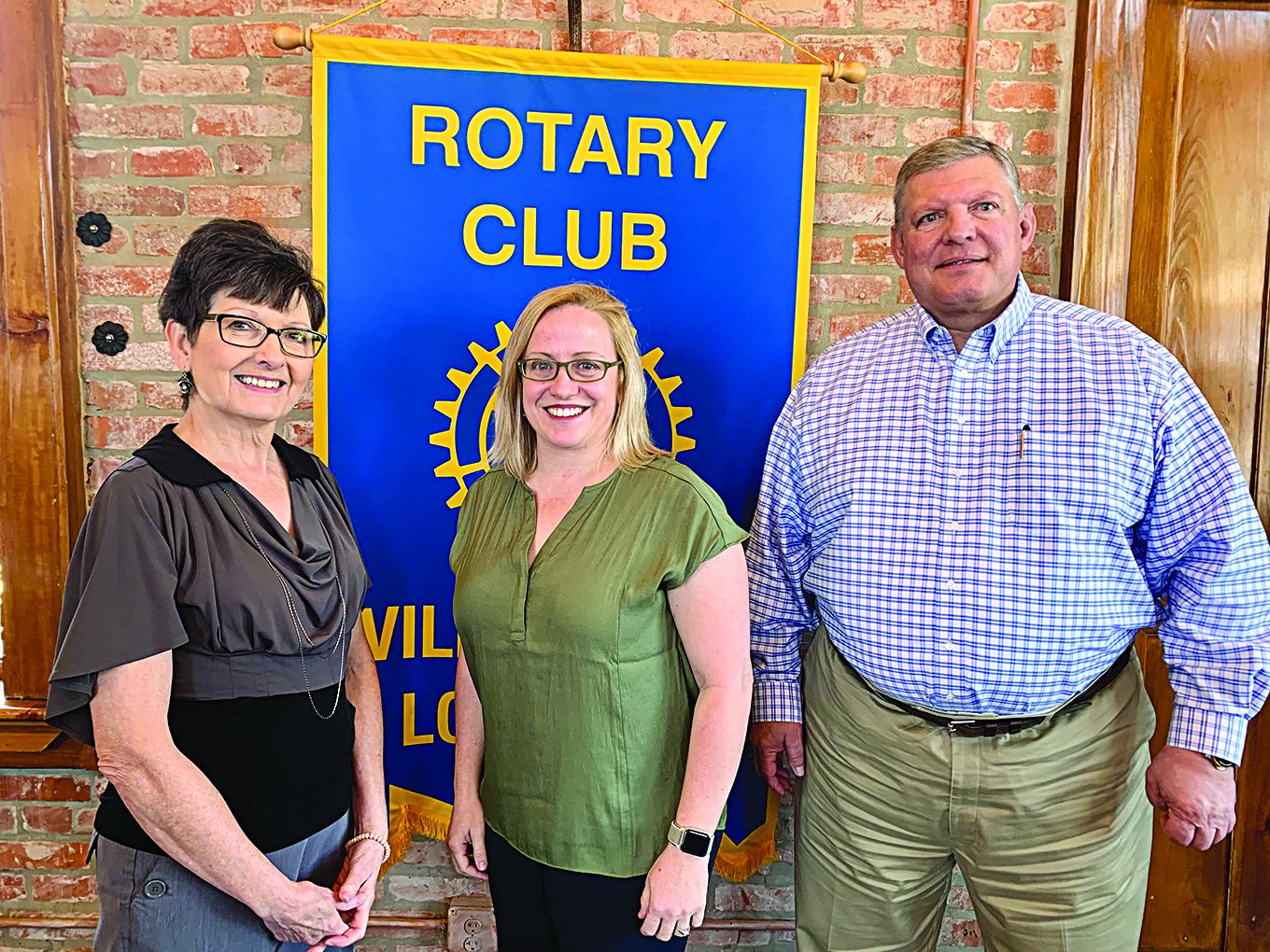
Trisha Ward is the new Chief Public Defender for Evangeline Parish. This is the first time the position has been held by a woman. Ward was the guest speaker at the April 20 Ville Platte Rotary Club meeting. She discussed public perception of her office, the challenges she faces, and her hopes for a more progressive system for the parish. Later, she sat down for a more in-depth interview.
While she cut her teeth practicing law in New Orleans, Ward grew up in Ville Platte and was a star athlete at Sacred Heart. The daughter of Dr. William “Tojo” Ward and Joane Ward, she credited her athletic career because it taught her discipline and introduced her to states in all areas of the Country as she travelled with her summer team.
As a teenager, Ward arose at 6:00 a.m. every morning, year round, despite the fact she played basketball, participated in four track events, and competed in tennis one year. “Every morning I repeatedly hit softballs off of a tee into a net,” she said. The discipline and hard work paid off, because Ward was named to the All American and All State teams all four years while at Sacred Heart. As a senior, two newspapers (one in Lafayette, one in Alexandria) bestowed upon her the highest honor in southern and central Louisiana by naming Ward the best Softball Player in the State.
After Sacred Heart, Ward received a full softball scholarship to the University of Florida where she majored in both kinesiology and psychology. When the first season ended, she transferred to LSU where she later discovered a teacher who focused solely on substance abuse research. That teacher became Ward’s mentor, and she joined in her work at Pennington Biomedical Research Center where she learned about individuals who had little resources and struggled in ways she had never been exposed to. That spurred her decision to pursue a career in the legal field.
Ward entered law school and initially hoped to land a job with the Human Rights Campaign. During her first year in law school, Sister Helen Prejean spoke to her class. Prejean is a nun who is an advocate for the abolition of the death penalty and has authored several books. One of her books, “Dead Man Walking,” was made into the 1995 critically-acclaimed film of the same name starring Sean Penn. That same year, Barry Scheck, the founder of the nationwide Innocence Project, was the featured speaker at LSU Law School.
After hearing stories of unjust practices in the criminal justice system, Ward was hooked. She clerked for the Innocence Project while in law school, then for a famous civil rights attorney, Mary Howell, and with the Gulf Region Advocacy Center (GRACE) to advocate for individuals sentenced to death. Ward credits Howelll, based in New Orleans, as extremely influential on her career.
On the subject of the death penalty, Ward noted 11 people sentenced to die on death row have been exonerated. She spent three years working as a public defender in New Orleans after law school, and then left to represent individuals who had been convicted and sentenced to death in Louisiana. One of the 11 exonerees who was released joined the staff at the organization where Ward worked. Her co-worker had spent 28 years on death row for a crime he did not commit. “It was incredibly sad, I had to remind him every day when it was time for lunch. For 28 years he relied on a bell or a guard to direct him to eat, so without a reminder he would forget.” When she went to his home, she noticed all of his cabinets were open. “I asked him what’s going on with this, and he said, ‘I just like to see my possessions,’ because he wasn’t used to that.” Ward said he is now in his first year of law school. “Those are the joys of my job.”
In 2017, Ward returned to her home town of Ville Platte because of several knee surgeries that left her unable to walk. She came here to receive help from her parents as she healed. Ward planned to remain in Ville Platte for four to five months, but when one surgery led to another, Alex Chapman, then the Chief Public Defender, asked her to handle Child in Need of Care cases. She eventually took on a felony case load when Chapman began to reduce his court duties, towards retirement, by stepping down as the leader of the office. She viewed the potential to lead a district public defender office as a once-in-a-lifetime opportunity.
Ward took over as the Evangeline Parish head public defender in January of this year, and she is learning the challenges of funding. According to Ward, public defenders face circumstances akin to David versus Goliath. “The State has immense power, unlimited resources, and at least a budget that exceeds the public defender’s by two-thirds,” said Ward.
On April 22, Ward testified before the Louisiana legislature regarding House Bill 586 which would abolish the State Public Defender Board. “It would throw us into chaos,” said Ward, who opposes the bill. Initially, the governor would appoint the State Public Defender for four years, and the Senate would have to confirm. After, the appointee would assume power with no mechanism in place to check his or her power. The Chief Public Defenders throughout the State would have no say-so in potential candidates for the State Public Defender position. “It’s a purely political decision,” said Ward, adding, “It creates a czar.”
Ward said this bill would take the legislative funds local public defender offices currently receive from money the sheriff collects and would send it to the State Public Defender who would then decide how to reallocate the money. “There’s no guarantee that we would get the money back,” said Ward. She said this could lead to her office being forced to stop taking cases due to crushing case loads and potential layoffs. “If this happens, because public defenders represent over 90% of individuals charged with crimes in the Parish, the justice system will come to an abrupt halt. People will languish in jail without an attorney. No one, victims or clients, would receive their day in court, and the judges’ dockets would become more bloated than during COVID. That is a huge concern of mine.”
Ward said at any given year throughout the state, public defenders represent 150,000 individuals who are charged with crimes. Going forward, her goal is to make her office client-centered rather than lawyer-centered or judge-centered. “My hope is to improve our citizens’ impressions of our office and to increase the level of representation, which also helps the entire system.”
Ward sees her office as representing people, not crimes. She said in urban areas people with addiction problems have easy access to mental health and drug abuse centers. In rural areas like Evangeline, access can be difficult for many. “A lot of poor people do not have access to transportation to get that help,” said Ward. “Oftentimes when I say I represent people, I may be the last person in line who’s willing to speak to them. They’ve had addiction problems for 10 years, their family is done with them, etc.” As a public defender, Ward noted the special and rare opportunity to connect with people society has forgotten. “Too many of my clients suffer from severe mental illness or chronic substance abuse. I struggle each day for a better answer to these issues than incarceration. The odds of change after spending years in jail is unrealistic. We as a society, I hope and pray, can do better. I will continue this work in hopes of realizing a better way.”
Ward, admittedly, is not sure how to fix this issue, but she remains adamant the main focus should be on education. “We need to reach people when they are young. By the time I encounter most of my clients . . . I will not say it’s too late, but earlier intervention can only help.” She mentioned an old Jewish saying that goes, If you save one life, you save the world. “I’ve represented thousands of people in my 15-year career, and while I can’t say with certainty I’ve saved a life, I’ve made a difference in enough people’s lives that I do feel like I’ve contributed to the world in that way.”
August 30, 2026
