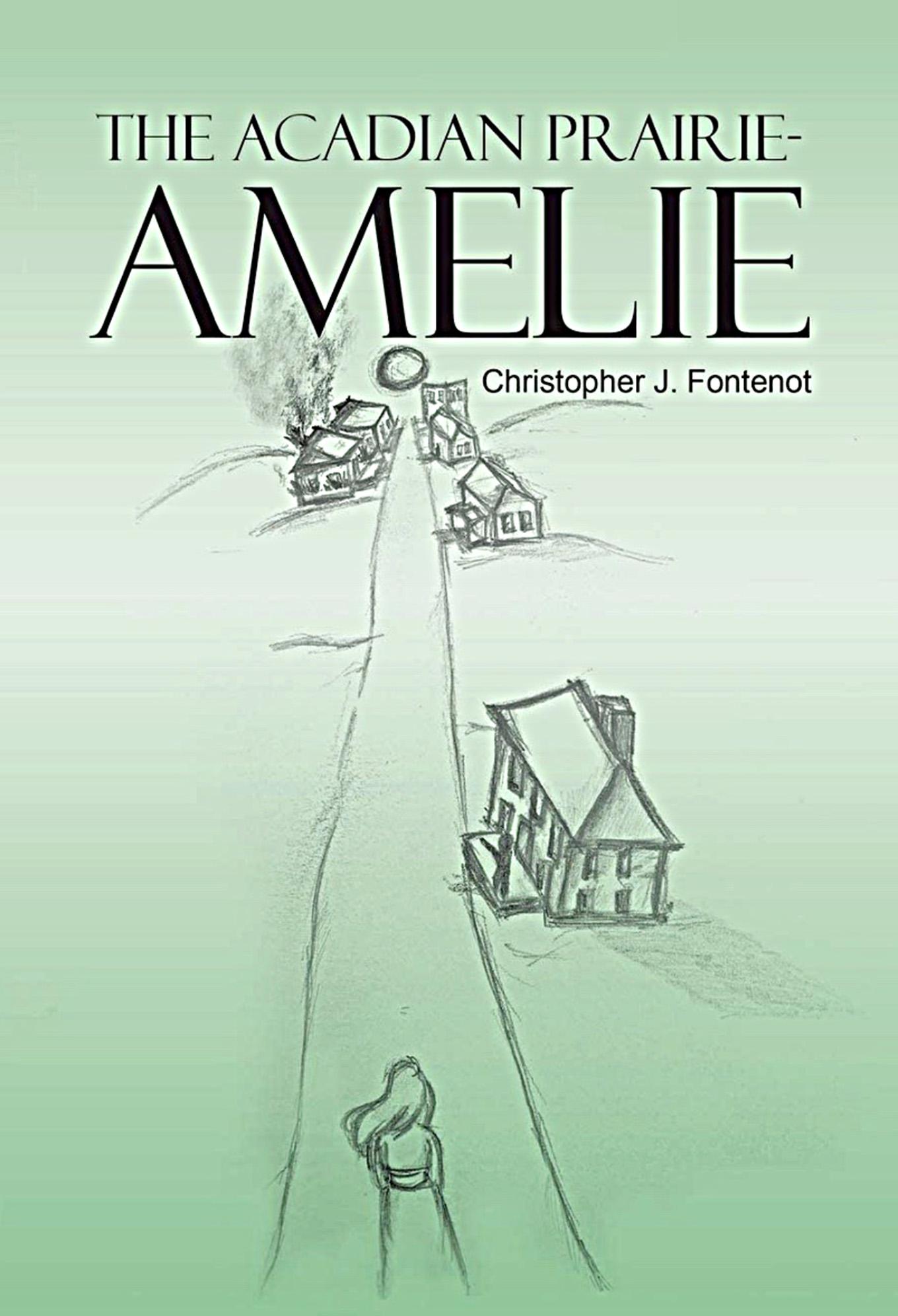
Ville Platte author Christopher J. Fontenot has released his new novel, Amelie, the third in the historical fiction series, the Acadian Prairie.
Fontenot said Amelie started out as an experiment in telling the same story as Octave, the titular character from another novel in the series, but as told from Amelie’s point of view. He got the idea from science fiction author John Scalzi, author of The Last Colony, who told the story of settling in a new planet and the problems they characters faced. Scalzi then wrote Zoe’s Tale, which is the same story from another character’s point of view. In the Acadian Prairie series, Amelie is the daughter of the main character of the last Prairie book, Maius, and essentially tells the same story that was covered in the story of her older brother, Octave. “Her story developed as a tale of her growing up on the Prairie, a coming-of-age story, while fully embroiled in the conflict between the Lees and Pitres on one side, and the complex Landry-Frugé-Dupré family on the other,” said Fontenot. “Her story carries the families from 1897 through 1903.”
When discussing how Amelie fits into the series, Fontenot described how he came about writing her story. “First, although Amelie’s relationships and ultimate engagement end early, Octave carried the story years forward to end in 1920, the climax of which is the Great Dance Hall Fire. Although Amelie was written last, chronologically, her story places her third of the five Prairie novels. Second, two other characters shoved their way forward to take almost equal attention. The three female leads pushed the page count over 900 pages so I had to scale back the development of one character. The other character, Yvette, however was such a fascinating, tragic character that I allowed the character arc to continue to develop. She also plays a prominent part in both Octave and the final novel, Joel. Finally, Fontenot said he realized there was too much repetition between the two stories, so he had to re-work Octave to make it more his story. “Amelie kept sneaking in and I had to keep her for some things. They were siblings. It’s not like I could ignore her,” said Fontenot. “Revising took time.”
In the Acadian Prairie series, Amelie is the daughter of Maius and his first wife. Amelie and her older brother Octave represent the third generation on the Prairie, which covers the years of the Gilded Age and, at the same time, the years of Jim Crow. “It also allowed me to research the Spanish-American War,” said Fontenot. “I sent two of my characters off to fight in that ‘Splendid Little War’ and return fragile but unbroken heroes. Although Acadians on the Prairie got very little benefit from the Gilded Age, everyone suffered through the years of Jim Crow and the social tensions of that era. Although my treatment is mild compared to some of the horrors that actually occurred to many African-Americans on the Prairie, their being forced to remain on the land and sharecrop for the landowners was realistic.” He added that Amelie presents a slightly different perspective than that of Octave. “Yvette, treated in a matter of half a dozen sentences in Octave, has nearly a third of Amelie to describe her ordeal as the Bayou Girl.
When asked how long it took him to write Amelie, Fontenot said, “Generally, it takes less than a month to craft a rough draft—when I am not otherwise distracted. It takes roughly twice as long to revise and refine the work, catching and correcting mistakes, weeding out inconsistencies, reviewing my research to be sure I am on target, and polishing… polishing… and more polishing. Even with that, mistakes slip through, sadly.”
There are five books in the Acadian Prairie, which Fontenot said was originally meant to be a semi-autobiographical remembrance of the Sacred Heart Class of 1969 and their four years in high school, which included four annual appearances in the state playoffs in football and the two fires that ultimately destroyed the old school. When he read Belair Cove by Dianne Dempsey-Legnon, he was inspired by her “rich treatment of early 1900’s Ville Platte.” He then thought back on Acadiana’s rich heritage and began to research events in this area. “Thus I thought to begin to write stories about times in the middle of the 1800s. Chataignier had been settled before 1790 and that was a great place to start. I started on a story (ultimately to be called Maius) and even as that story neared completion, I realized that even earlier in this area there were several events that would have made a great story, (and movie, truth be told) so I wrote Theodule starting with his early adolescence in the year of the Texas Revolution, 1835, so I could weave into the tale the last members of the Choctaw tribes, slaves, and the somewhat mysterious Traiteurs and Traiteuses. There was the Vigilante-Anti-Vigilante war, and the Civil War, which did not leave the area untouched, what with Union raids, forced conscription by the Confederates, and the Jay Hawkers, who devastated Acadiana.”
Ultimately, Fontenot’s tales would encompass four generations. It then occurred to him that it would be “quite satisfactory to I followed the lives and loves of the same families through those generations. Thus I followed the fictional Dupré family, their chief rivals among the Pitre and Lee families, the descendants of the slave woman Kaylie and her daughter Cicily, who eventually carries through the first four novels as a traiteuse.”
After Octave is published, the final story of the series, that of Octave’s son, Joel, will cover the years from 1930 through about 1960. “At that point, the main characters in the Class of 1969 will all be in place.”
Amelie and the other books in the Acadian Prairie series are available from Amazon.com, or can be purchased directly from Fontenot.
July 11, 2026
