
In the American psyche, their are dates such as March 6, 1836, and December 7, 1941, that are forever etched as turning points in our country’s history. Twenty years ago came another one of these dates when two airplanes crashed into the World Trade Center in New York. Also, another airplane crashed into the Pentagon and another in a Pennsylvania field.
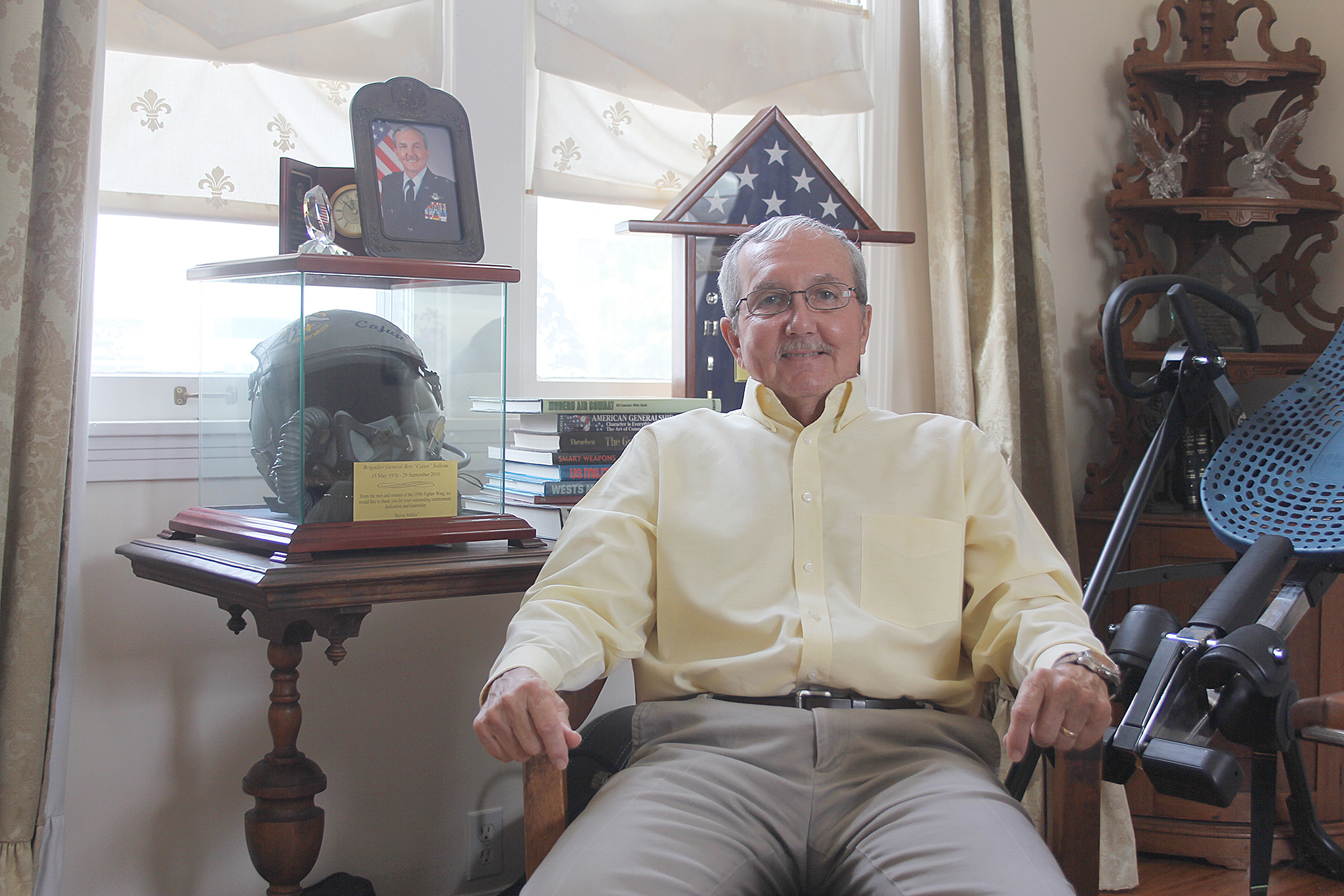
For Ville Platte native Ben Soileau, who is now a deacon at Our Lady, Queen of All Saints, he had a front row view of the events following the terrorist attacks as he was wing commander of the Louisiana Air National Guard in New Orleans.
Soileau’s journey becoming the wing commander began after being a distinguished graduate of the Air Force ROTC at the University of Southwestern Louisiana. He then became one of two guys chosen out of about 14 to attend pilot school after joining the Air Force.
After an assignment in Hawaii, Soileau was granted his request to begin flying F-15s at Eglin Air Force Base in Fort Walton Beach, Fla. in 1981.
Four years later, he joined the Air National Guard in New Orleans. At that time, they had just gotten F-15s.
Then, the following year, Soileau took a job with the United States Customs Service. “I was going to carry a gun and a badge and chase bad guys,” he said. “I did that concurrently for about 14 years, and then I was approached by the adjutant general about coming back full time with the Guard. I came back as the vice wing commander at New Orleans in 1999, and, in 2000, I assumed command of the fighter wing.”
At the same time, Soileau assumed to the rank of colonel.
“When I took the wing over,” he said, “we had an aggressive schedule because we were starting this new thing called Combined Expeditionary Force. We went to Saudi Arabia, and it just so happened we arrived in Saudi Arabia the night of the attack on the USS Cole.” We came back from that, and we scheduled another overseas deployment. Normally, you only do one a year, but we scheduled another one to Australia.”
He continued, “Then, we came back, and in the summer of 2001, in July, we went to Alaska. That was our third overseas trip in 15 months, which is kind of unprecedented for a Guard unit. The guys all wanted to do it, and we had more volunteers than we could handle. We had just finished all of that by the end of August. It was time to slow down and take a break.”
But, then, came a phone call that sent the wing again into action.
On the morning of September 11, 2001, Soileau was sitting in his office, which was on the side of the office of the senior enlisted person Randy Volpe.
“I was doing my regular paperwork and different things,” Soileau said. “At about five minutes to 8 a.m., Randy walked over and asked if my TV was on. He said something was going on in New York. I turned the TV on and flipped through the channels and found CNN. They were saying a small airplane had hit the World Trade Center. I looked at Randy and said that’s not a small plane. That’s big.”
“Then right after 8 a.m. as I’m watching and Randy and I are talking,” he continued, “we see it live where the other airplane flies into the other tower. I said this is an attack. Randy and I started scrambling and got on the horn to tell the guys what was happening.”
That was when the phone rang. The person on the other end of the call asked Soileau if he knew what was going on and said he could not say who he was. Soileau knew, however, he was either from Washington, D.C., or the Pentagon.
The caller then recommended Soileau to arm the jets. “That’s what I planned to do anyway,” Soileau said.
Soileau then contacted the maintenance operations center to begin loading the jets with missiles and guns. “I walked over there, and I was watching the people just doing it,” he said. “I remember walking with Chief Volpe, and I said it was like we just took the bridle and saddle off of a wild horse. The men knew what they were doing and were doing it well.”
Another phone call came moments later advising Soileau about a high priority mission. “We didn’t know what it was exactly,” he expressed, “but they wanted us to launch four planes and start heading north. The squadron commander and three people cranked up the jets, taxied out, and took off. They basically escorted (President George W.) Bush from Barksdale Air Force Base to Offutt (Air Force Base in Nebraska).”
Meanwhile, back in New Orleans, Soileau and the rest of his wing began loading up the remaining jets for Operation Noble Eagle where they began flying air combat missions over Houston. As Soileau said, “We’d fly over Houston and make sure nobody was trying to attack Houston.”
Two days after the terrorist attack, Soileau flew one of the missions over Houston. He recalled, “This was after everybody had been grounded, so there was nobody in the air. We had fully armed jets, and it was the eeriest flight I think I ever had in an F-15 because it was dead quiet, and there was not another airplane in the sky over Houston. Houston is normally busy with airplanes everywhere.”
After completing the mission over Houston, Soileau returned back to New Orleans and assumed his wing commander duties.
All these years later, Soileau sees what is currently happening in Afghanistan and is disgusted. “Maybe I’m tainted a little because of what happened on September 11,” he expressed. “It’s like we completely forgot what happened to us on that day. For a while, everybody was waiving flags, and now the country is so far away from where we were 20 years ago.”
He went on to say, “It’s very disconcerting and very disheartening to me. I’m really glad I’m working in the church because that gives me solace that I’m trying to do God’s work right now.”
With the anniversary approaching, Soileau hopes to see programs on television about September 11. “Because of the networks that our former administration called ‘fake news,’” said Soileau, “I’m not sure how much they’re going to talk about that because they don’t want to remind people of what happened to us which was originated in Afghanistan. We just left Afghanistan with our tail between our legs.”
Regardless of how the events in Afghanistan played out, Soileau is still honored to have been a part of history.
As he concluded, “I was so happy I was right there because it was a tough decision to leave customs. But, I was happy that I was given the opportunity to be part of the fighter wing especially the wing commander and watch what was going on. I’m glad I was able to be a part of it.”
- Log in or Subscribe to post comments.